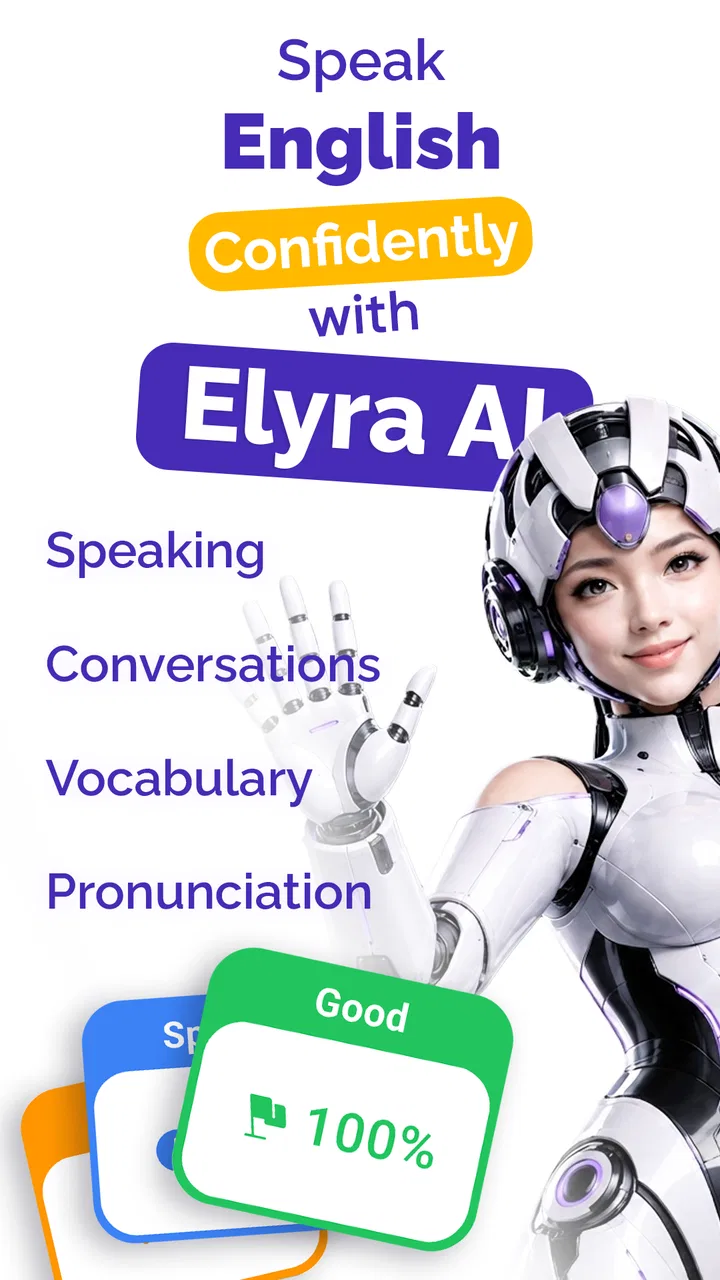
Elyra: AI English Coach
- 3.5
- Rating
- 1.00M
- Installs
- Free
- Price

 Analysis by App-foxy
I approached Elyra - AI English Coach as an English-learning companion rather than a complete language course. Its central idea is appealing: use an AI tutor to help me practise speaking, hold conversations, and build vocabulary without waiting for a teacher or conversation partner. In daily use, that makes the app feel more approachable than a workbook, especially when I want to practise a sentence out loud without worrying about making a mistake in front of somebody else.
Elyra comes from Astronex AI and sits in the education category. It is free to install, aimed at Everyone, and has passed the half-million-install mark. Those details make it easy to try, but they do not automatically make it the right learning tool for every student. My main question was not simply whether it could help with English, but whether its AI-led format gave me enough control over practice and enough clarity around the moments when I would be sharing language input with an app.
How Elyra feels as an AI speaking coach
The strongest part of the concept is the reduction of pressure. Traditional speaking practice often depends on arranging a lesson, finding a partner, or feeling confident enough to start a conversation. Elyra offers a more private space for experimenting with vocabulary and spoken English. I can imagine using it when I know what I want to say in my head but hesitate when speaking, which is a very different problem from simply not knowing grammar.
You May Also Like

 Blood Strike: 2.5 Anniversary
Blood Strike’s Loadouts Turn Every Drop Into a Tactical Gamble
A close look at Blood Strike’s custom loadouts: how fast access to signature weapons reshapes its battle royale rhythm, rewards preparation, and narrows the gap between fights.

 Pandora - Music & Podcasts
Pandora’s Music Is Easy to Start, but Harder to Recover
Pandora’s strength is its low-effort path from a seed to a station. Its weak spot is how much confidence it asks you to place in connection, setup, and quiet recovery.

 8 Ball Pool
 Is Built on Rivalries, Rematches, and Routine
A close look at the rivalries, rematches, shared routines, and unanswered safety questions that turn a quick pool match into a persistent mobile community.

 Samsung Music
’s Quiet Strength Is Playing What You Already Own
Its reach comes less from spectacle than from dependable access to a personal library. That simplicity is both the app’s strongest retention engine and its ceiling.

 AccuWeather: Weather Radar
AccuWeather Review: A Quick, Clear Forecast for Everyday Decisions
For everyday plans, the best forecast is the one you can understand quickly. AccuWeather makes rain timing, radar, and local conditions easy to act on, with a few trade-offs.

 Hill Climb Racing
Why Hill Climb Racing Still Turns Crashes Into One More Run
A tiny car, a bumpy hill and one more upgrade: Hill Climb Racing keeps resurfacing because its simple chaos makes every near-miss feel personal.
More From Our News Desk



The app is also more focused than a general translation tool. A translator may help me understand one sentence, while Elyra is designed around repeated practice. That distinction matters. If I am preparing for a short conversation at work, travelling, or trying to become more comfortable with everyday English, an interactive tutor can encourage me to produce language instead of only recognising it.
At the same time, I would not treat an AI conversation as a replacement for a human teacher. An AI coach can make practice available at convenient times, but it cannot fully reproduce the social pressure, interruptions, accents, body language, or specialised correction that comes from a real person. I see Elyra as a low-friction practice layer, not as a complete curriculum or formal assessment system.
A practical routine for busy learners
A useful way to approach Elyra is to give each session a small purpose. Instead of opening it with the vague goal of “improving English,” I would choose one situation: introducing myself, describing my work, asking for help, ordering food, or explaining a recent problem. This keeps the conversation manageable and gives me something specific to notice afterwards.
One realistic scenario would be a learner preparing for a short video meeting with international colleagues. Before the meeting, I could practise explaining a project in simple terms, then repeat the same idea with more precise vocabulary. The value is not just memorising words. It is discovering which parts of the explanation make me pause, lose the sentence structure, or fall back on my first language.
For vocabulary, I would keep a small personal list outside the app as well. When Elyra introduces a useful word, I would write one sentence connected to my own life rather than copying an isolated definition. That extra step turns passive recognition into something I can retrieve later. It also gives me a way to continue studying if I decide not to keep using the app.
What makes the format different from familiar alternatives
Compared with flashcard apps, Elyra appears better suited to active recall through conversation. Flashcards are efficient when I need to review a known set of words, but they do not always show whether I can use those words naturally in a sentence. Elyra’s conversational focus addresses that gap. The trade-off is that a flashcard system can be more predictable, easier to measure, and easier to organise around a textbook or exam syllabus.
Compared with grammar-focused courses, the AI tutor approach feels less rigid. That can be motivating for a learner who becomes bored by sequential exercises. However, a structured course may be the better choice when I need a clear progression through verb forms, writing tasks, listening drills, and exam-style practice. Elyra is most convincing when the immediate goal is to speak more often, not when the goal is to follow a carefully mapped academic programme.
Compared with a human tutor, the obvious advantage is convenience. I do not need to coordinate schedules or feel embarrassed about repeating a basic phrase. The disadvantage is that I have to take more responsibility for judging whether a correction or suggested expression really fits the situation. I would use Elyra for frequent rehearsal and a teacher for nuanced feedback, accountability, and high-stakes preparation.
Trust, controls, and moments that deserve attention
Because Elyra is an AI learning app, trust is part of the experience, not an extra consideration. Speaking practice can contain personal details even when the exercise seems harmless. A learner might mention a workplace, a family situation, a travel plan, or a health concern while trying to form a sentence. I would therefore keep practice examples fictional or general unless I had deliberately checked the app’s current privacy information and understood how account and conversation controls work.
The safest habit is to separate language practice from personal disclosure. Instead of describing my real employer, I could say “a small company.” Instead of naming a real person, I could use “my colleague.” This does not reduce the learning value, because the grammar and vocabulary remain almost identical. It simply limits the amount of unnecessary context attached to a speaking exercise.
I would also review the choices shown during setup and inside the account area before beginning regular practice. In particular, I would look for any visible controls concerning account access, conversation history, personalisation, notifications, and purchases. I would not assume that an AI tutor handles information in the same way as a paper notebook or an offline dictionary. The important point is to use the choices the app visibly provides rather than treating convenience as permission to share everything.
That caution is especially relevant for younger learners. The age classification is Everyone, which makes the app broadly accessible, but an age label is not a substitute for supervision or a conversation about safe sharing. Parents should help children understand that an English exercise does not require real names, addresses, school details, passwords, or private family information. I would also check the device’s purchase protections before allowing unsupervised use.
Account and payment awareness
The app is free to start, which lowers the barrier for a short trial. It also includes in-app purchases ranging from $9.99 to $179.99 per item. That is a wide enough range that I would pay close attention to the purchase screen, the billing period if one is shown, and the wording around any upgrade before confirming anything. I would never treat a promising conversation as a reason to buy immediately.
My preferred approach would be to use the free experience first with a clear test plan. I would try several speaking situations, see whether the feedback is understandable, and decide whether the practice actually changes how confidently I form sentences. If the app asks for an account, I would use only the information needed to operate it and would check the available account controls before adding more personal details.
Purchase control is also a practical part of trust. On a shared family device, I would enable the operating system’s purchase approval or password requirement. On my own device, I would still read the confirmation screen carefully rather than tapping through quickly. The presence of a free entry point is useful, but it does not mean every learning feature will remain free, so the decision should be based on visible terms and personal value.
Where AI feedback needs a human check
AI-generated language help can be useful and still require judgement. English often has several acceptable ways to express the same idea, and the most natural choice depends on tone, region, relationship, and context. If Elyra suggests a phrase that sounds unusually formal, too casual, or simply unfamiliar to me, I would verify it with a trusted dictionary, a teacher, or a reliable language reference rather than memorising it automatically.
I would use a two-pass method for important practice. First, I would answer naturally and avoid interrupting myself to chase perfection. Then I would review the corrections and choose only one or two changes to repeat. Trying to fix every issue at once can make speaking feel mechanical. Selecting a small target, such as past-tense verbs or clearer question forms, gives the session a more useful outcome.
Another non-obvious limitation is that conversational confidence can grow faster than overall language accuracy. A learner may become comfortable producing familiar patterns while still avoiding difficult grammar or unfamiliar listening situations. To balance that, I would occasionally pair Elyra with reading, listening to different speakers, and writing a short paragraph. The app can support speaking practice, but it should not become the only source of English input.
Who will benefit most from Elyra
I think Elyra is a good fit for learners who understand some English but need more opportunities to use it actively. It should appeal to people who dislike speaking in groups, have irregular schedules, or want a private rehearsal space before a real conversation. It may also help someone who knows many words but struggles to retrieve them quickly when speaking.
It is less suitable as a sole solution for complete beginners who need carefully sequenced explanations, or for advanced learners seeking specialised professional editing. It is also not my first choice for a student preparing for an exam with strict marking criteria. In those cases, a structured course, an experienced teacher, or an exam-specific platform would provide clearer coverage and more dependable evaluation.
Privacy-conscious users should not automatically reject the app, but they should use it deliberately. The sensible boundary is simple: practise language without feeding the tutor a diary of real-life details. Users who want entirely offline study may prefer books, downloaded audio, or a locally stored flashcard system instead. Elyra’s appeal comes from interactive AI practice, so that appeal naturally depends on being comfortable with the app’s visible account and data choices.
What I would check before committing
Before making Elyra part of my routine, I would answer a few practical questions through direct use. Does the conversation encourage me to speak in complete thoughts, or do I only produce short replies? Are corrections clear enough to apply immediately? Can I understand why a phrase is being changed? Do the available controls make me comfortable with the account and purchase experience? These questions tell me more than the store summary alone.
I would also test whether the app fits my learning style over several short sessions rather than one long first impression. A tutor can feel exciting on day one but become less useful if the practice lacks variety or if I cannot identify progress. Keeping a simple note of the situations I practised and the mistakes I repeatedly made would help me judge the app fairly without relying on enthusiasm.
The current release is version 0.3.0, so I would approach it as a developing product rather than assuming it has the maturity of long-established language platforms. That does not make it unsuitable. It simply means I would pay attention to how stable the experience feels, how clearly the app explains its choices, and whether updates improve the areas that matter to my routine.
My verdict after weighing usefulness against caution
Elyra has a clear and worthwhile role: it makes English speaking rehearsal feel more private and accessible. I like the idea of opening an app when I have ten spare minutes, choosing a familiar situation, and practising without waiting for a class or partner. Its conversational emphasis gives it a practical advantage over vocabulary-only study, particularly for learners who already know basic English but rarely use it aloud.
My recommendation comes with boundaries. I would keep personal details out of practice conversations, inspect the visible account and purchase controls, and treat AI corrections as suggestions to evaluate rather than unquestionable facts. I would also combine Elyra with listening, reading, writing, or human feedback if accuracy and broad fluency were important goals.
With those expectations, Elyra - AI English Coach is worth trying for learners who want flexible speaking practice and are comfortable making thoughtful choices about what they share. I would skip it as a complete replacement for a teacher or structured course, but I would consider it a useful companion for turning passive English knowledge into more regular, confident speech.
Its average rating is 3.4 from around 547 ratings, which suggests a mixed reception rather than universal approval. I would read that as a reason to test the free experience personally, not as a final verdict. The app’s real value depends on whether its AI conversations match my level, whether the feedback helps me change specific habits, and whether its controls feel clear enough for the way I want to study.
FAQs for Elyra: AI English Coach
01What is Elyra - AI English Coach, and who is it designed for?
Elyra - AI English Coach is an English-learning application that uses artificial intelligence to support practice with speaking, vocabulary, grammar, and everyday communication. It is designed for learners at different levels, from beginners who need structured guidance to more advanced users who want additional conversation practice. Before downloading, check whether its lesson style and available learning paths match your personal goals.
02How does Elyra help users improve their English speaking skills?
The app is intended to provide interactive English practice rather than only passive lessons. Users can typically work on conversations, respond to prompts, and receive guidance intended to help improve fluency, word choice, and confidence. As with any AI language coach, feedback may not always understand accents, context, or unusual answers perfectly, so it should be treated as useful practice support rather than a complete replacement for a teacher.
03Is Elyra - AI English Coach suitable for beginners?
Elyra can be useful for beginners if they are comfortable learning through a mobile app and practicing regularly. AI-based exercises may allow learners to repeat activities at their own pace, review unfamiliar expressions, and build confidence without the pressure of speaking to another person immediately. However, beginners should verify the app’s current language options, lesson difficulty, and introductory content before subscribing or relying on it as their only English course.
04Is Elyra - AI English Coach free to download and use?
The application may be available to download without an upfront charge, but some features, lessons, conversation tools, or advanced feedback can require in-app purchases or a subscription. Pricing, trial periods, and included features may vary by platform, country, and time. Review the Google Play or App Store listing carefully, especially the renewal terms, payment schedule, and cancellation instructions, before starting any free trial.
05Does Elyra require an internet connection, and what should users know about privacy?
Because Elyra relies on AI-powered processing and may analyze written or spoken English, many of its main functions are likely to require an active internet connection. Users should also read the app’s privacy policy to understand how voice recordings, typed messages, account details, and learning activity are handled. Avoid entering sensitive personal information into practice conversations, and review microphone and other permissions before granting access.
Pros
- Personalized AI feedback helps target individual English weaknesses.
- Useful for practicing speaking without the pressure of a human conversation partner.
- Available anytime
- making short daily practice sessions easy to fit in.
- Conversation-based exercises can make routine language practice more engaging.
- Helpful for learners who want extra practice between formal lessons.
Cons
- AI feedback may occasionally misunderstand accents or conversational context.
- Advanced learners may find some exercises too basic or repetitive.
- A stable internet connection may be required for several core features.
- AI coaching cannot fully replace nuanced feedback from a qualified teacher.
- Some useful lessons or features may require a paid subscription.

Elyra: AI English Coach
Gallery